
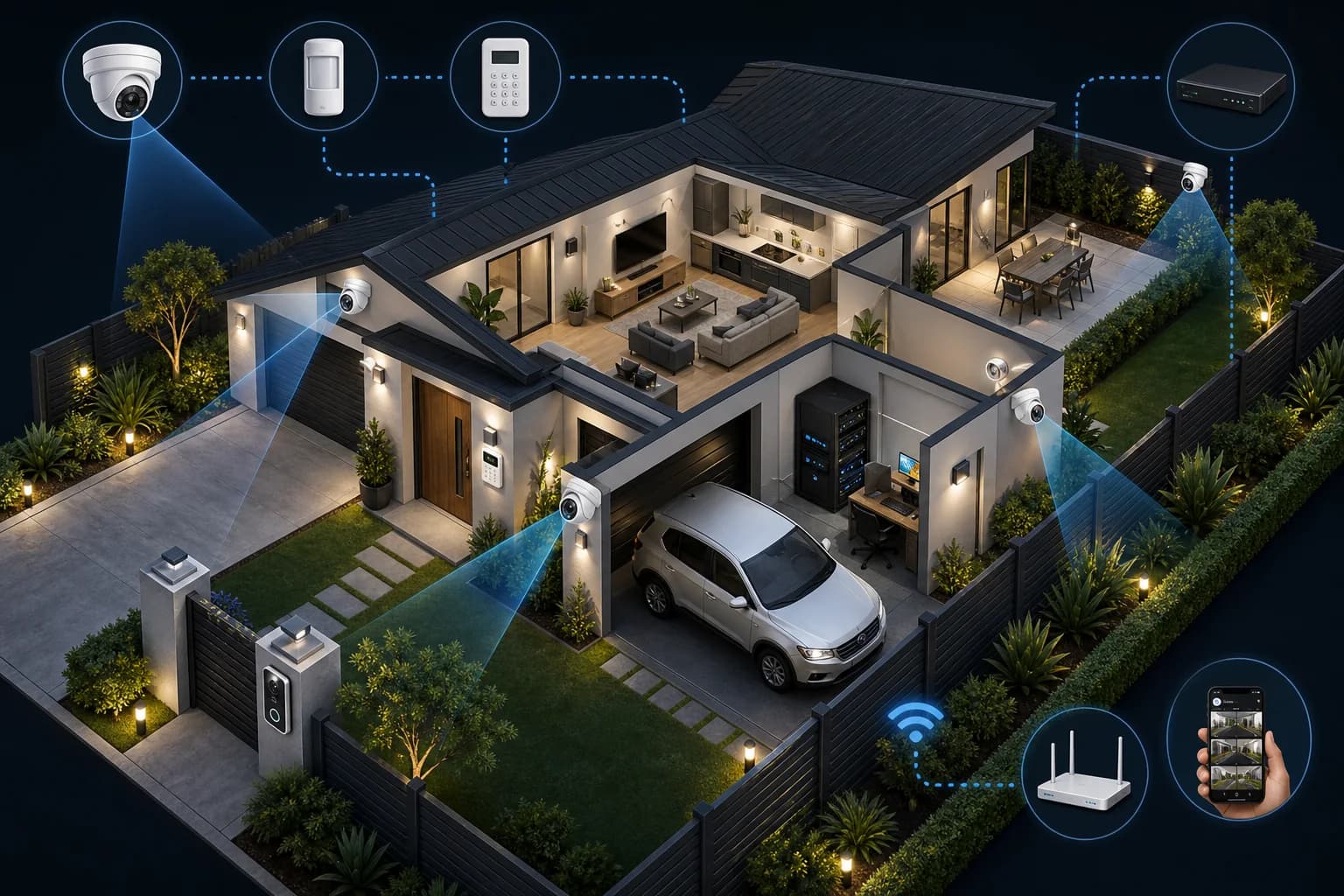
Who this helps
Use camera count as a starting point, then check it against the property.
Four, six, eight, and custom systems can all be right or wrong. The best package depends on the areas to cover, storage needs, cabling, and app access.
Starter coverage
A 4-camera system works best when the property has four clear priority views. It is a focused layout decision, not a promise that every small property only needs four cameras.

Protect what matters
Clean install path
Phone access and playback tested
What this helps you solve
Clear answer before you enquire.
A 4-camera CCTV system may suit a compact home or small site when four cameras can give useful views of the front entry, driveway or garage, side access and rear entry. The final count and quote depend on the property.
Fit
Camera count only works when it matches the property.
Check
Cable access, recorder storage, app setup, and night footage.
Next
Send the coverage areas if the camera count feels like a guess.
Who this helps
Four, six, eight, and custom systems can all be right or wrong. The best package depends on the areas to cover, storage needs, cabling, and app access.
What we check
Before choosing a package
Four, six, eight, and custom systems can all be right or wrong. The layout, cable access, recording needs, and app setup decide the real fit.
Camera positions
The quote should be based on the actual need: entries, vehicles, tools, stock, staff areas, side access, business areas, signal issues, or old-system gaps.
Cable and network path
A clean install depends on where cable can run, where the recorder sits, and whether the network can support remote viewing.
Recorder and storage
The recorder setup should match camera count, footage quality, storage expectations, and how often footage needs to be reviewed.
Handover
The system should be tested, the app should be set up where needed, and the basic playback process should be clear.
Package detail
Use the package as a starting point, then let the property layout prove whether the camera count is actually right.
Coverage-zone check
The package is compared against entries, driveway, side access, rear areas, business zones, and blind spots.
Recorder fit
Camera count affects storage, playback, app setup, and how easy footage is to find later.
Cable path check
The package only works if the property can support the camera positions cleanly.
Insufficiency check
A second side path, detached structure, long approach or extra business zone can expose a fifth required view.
Decision path
Use this count
Best for: Compact homes, townhouses and small sites with four clearly ranked views.
Watch: A second side path, detached structure, long approach or extra business zone can expose a fifth required view.
Move up/down
Best for: Properties where one or two extra views change the usefulness of the system.
Watch: More cameras are not better if placement is weak.
Go custom
Best for: Commercial, wide, awkward, or multi-zone properties.
Watch: Needs better planning before quoting.
Compact homes
Four defined external views with limited competing approaches.
Townhouses
Entry, garage, courtyard and one shared-area-sensitive approach where permission allows.
Small shopfronts
Entry, counter, stock access and rear door when those are the four priority incidents.
Simple upgrades
Existing four-channel layouts where cable, recorder and camera compatibility still pass.
Package fit check
A package is only useful if it matches the areas to cover, cable path, recorder needs, and handover expectations.
Where this can work
This camera count can be a useful starting point when the property fits the number of views without forcing wasted angles.
What can make it wrong
Long cable runs, awkward roof access, wide outdoor areas, poor lighting, or multiple business zones can push the job toward a different layout.
Recorder and app fit
More cameras can mean more storage, better playback habits, and clearer handover. The recorder and app setup need to match how the footage will be used.
Quote detail to send
List the zones you expect each camera to cover. If the list feels forced, send the property details and we will work from the layout instead.
Compact houses, townhouses and small sites with four obvious approach or incident zones can be good candidates. Start by naming the four views that would matter after an incident.
A common planning set is front entry, driveway or garage, one side path and the rear entry. On a small shopfront, the four views may instead be entrance, counter, stock access and rear door.
One wide camera cannot always provide both a useful overview and identifying detail. Long driveways, two side paths, detached structures or several doors can make four views too thin.
The recorder needs enough channels for the chosen cameras, storage settings should match how footage will be reviewed, and the network path must support phone access where required.
Move beyond four when an important entry, vehicle area, side route, rear zone, business area or low-light view would otherwise be missed or forced into an unhelpful angle.
Send the suburb, property type, four proposed views, any extra areas you are unsure about, photos of the approaches, and details of existing cameras or a recorder if this is an upgrade.
Coverage planning
A home CCTV layout should be based on the views that actually matter: entries, driveway, side access, rear doors, and low-light approach points.
Zone 01
Front entry
Visitors, deliveries, faces, and the main approach.
Zone 02
Driveway
Vehicles, garage access, and movement near the street.
Zone 03
Side access
Narrow paths, gates, bins, and blind spots.
Zone 04
Rear entry
Back door, patio, yard, and low-light approach points.
Quick answers
It can be when four positions cover the important entry, driveway, side and rear views. A wider block, extra door, shed or long side access can require more.
Prioritise the views most likely to help after an incident. That is often the front approach, vehicles, the easiest unseen side route and the rear entry, but the property decides.
Phone viewing can be planned where the recorder, internet connection and app support it. It should be tested with live view and playback during handover.
Storage depends on resolution, frame rate, recording mode and the retention period you want to discuss. No storage duration should be assumed from camera count alone.
No. It is a planning guide. Final camera count, equipment, installation scope and quote depend on the property.
After you enquire
We use the job details to work out the most useful next step before anyone guesses at camera count or equipment.
Confirm what matters
Tell us whether the package is for home safety, cars, tools, stock, counters, loading areas, signal, screens, or a wider site layout.
Check if the package fits
We compare camera count against the property, cable access, recorder needs, app setup, and any upgrade constraints.
Move from package to plan
If the package is right, it becomes the starting point. If not, we point the quote toward the layout that makes more sense.
Specialist, not handyman CCTV